

Destination
Luang Prabang
The story
Sin savanh ("heavenly meat") is Laos's beef jerky, and unlike any Western beef jerky you've eaten. Thin strips of lean beef are marinated in a specific sweet-savoury paste of fish sauce, palm sugar, garlic, black pepper, coriander seeds, and sometimes a splash of dark soy or oyster sauce, then air-dried in the sun (on a wire rack, covered with mesh to keep the flies off) for 6 to 24 hours until the outside is dry and leathery but the inside still has some moisture. To eat, the dried strips are briefly deep-fried in hot oil (1 to 2 minutes only) until the outside crackles and the sugars caramelise into a sticky glaze. Served alongside sticky rice, jeow bong and a plate of raw vegetables.
Method
In a large bowl, combine the fish sauce, palm sugar, soy sauce, oyster sauce, garlic, coriander seeds, black pepper, white pepper, salt and sesame seeds. Whisk to dissolve the sugar. Add the beef strips and toss well to coat every piece. Cover and refrigerate at least 4 hours, ideally overnight, turning once.
TRADITIONAL SUN DRYING: Arrange the strips in a single layer on a wire rack. Cover with mesh (to keep flies off) and dry in strong sun for 6 to 8 hours, turning once, until the outside is dry and leathery. OVEN METHOD: Preheat oven to 60°C (140°F). Arrange strips on a wire rack over a baking tray. Dry in the oven with the door slightly ajar for 4 to 5 hours, turning once. DEHYDRATOR: 8 to 10 hours at 60°C (140°F). The finished strips should be dry to the touch but still slightly flexible (not brittle).
Cool the dried beef fully. It can be stored in an airtight container in the fridge for up to 2 weeks, or in the freezer for months.
Heat the oil in a wide heavy pan to 180°C (355°F). Fry the dried beef strips in small batches for 60 to 90 seconds each, turning once, until the outside crackles and the sugars caramelise into a glossy dark bronze. Don't overcook; longer than 90 seconds turns them to leather.
Lift onto kitchen paper for 30 seconds to absorb any excess oil.
Arrange the fried sin savanh on a plate. Serve immediately alongside warm sticky rice, jeow bong and raw vegetables. Guests tear strips of sin savanh, wrap them in sticky rice with a dab of jeow bong and a leaf of vegetable, and eat with their fingers.
Tips
- Slice against the grain. Cutting the beef across the muscle fibres (not with them) makes the finished sin savanh tender rather than stringy. Freeze the beef briefly (30 min) before slicing for cleaner cuts.
- Overnight marinade. Four hours is the minimum; overnight in the fridge lets the fish sauce and sugar penetrate deeply and gives you the classic sweet-savoury depth.
- Dry to "still slightly flexible", not brittle. Over-dried beef is impossible to fry properly and stays tough. Aim for the strips being dry to the touch but still bendable, like well-cured biltong.
- Fry hot and fast. 60 to 90 seconds only at 180°C. The point is to crackle the outside and caramelise the sugars, not to cook the beef further (which is already fully dried).
- Buy pre-dried from Lao and Thai grocers as a shortcut. Vacuum-sealed packets of sin savanh (or the Thai equivalent, neua yang haeng) are widely sold; just fry to serve. Home-drying gives you more control, but the shortcut is legitimate.
More recipes
View all
Roasted chillies, garlic and shallots pounded to a thick paste with fried pork skin, fish sauce and a little palm sugar. Laos's national condiment, served with sticky rice and raw vegetables.

Butterflied chicken marinated in lemongrass, garlic, coriander root and fish sauce, then grilled hard over charcoal. Served with sticky rice and jeow bong.
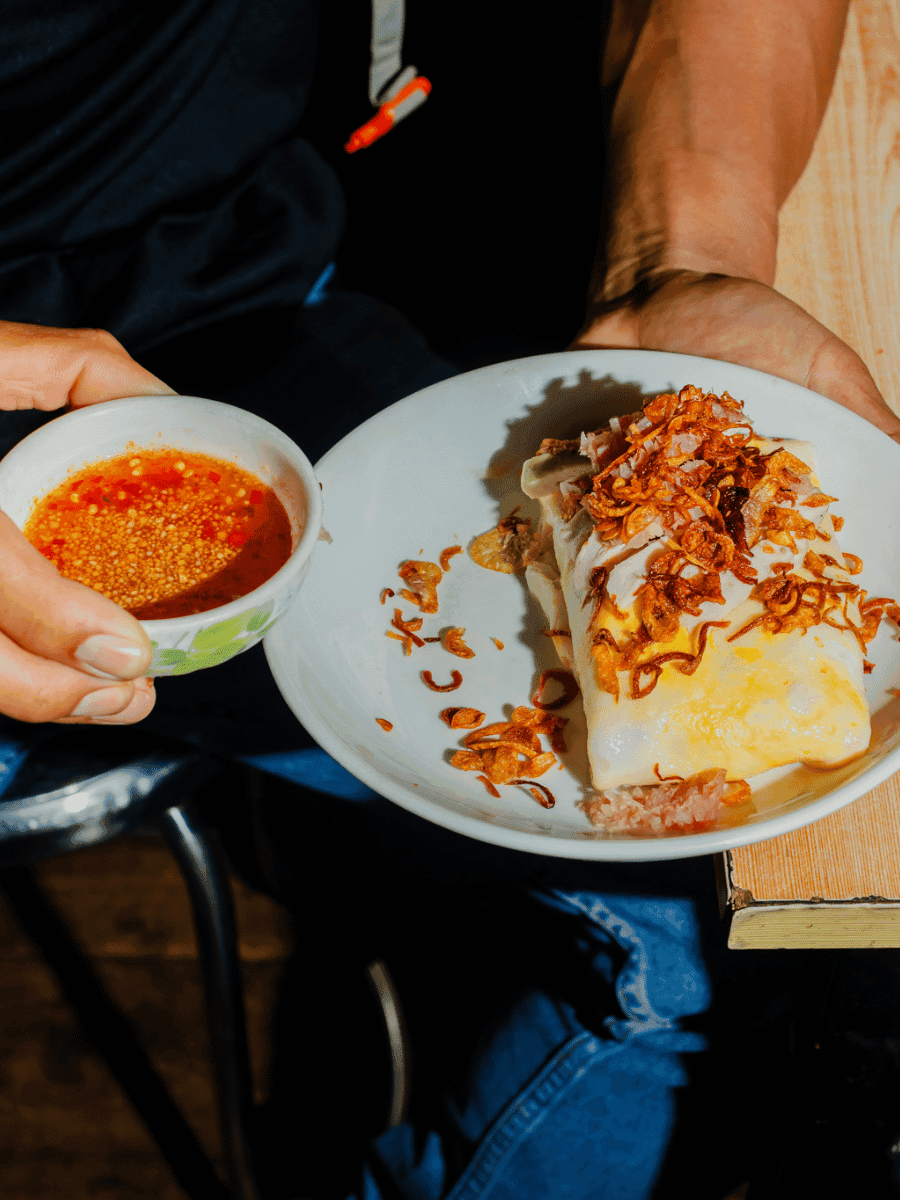
Steam-set rice noodle rolls filled with pork and wood-ear mushroom, served with sliced grilled sausage and fresh herbs. Luang Prabang morning market's Vietnamese-Lao crossover.

Green papaya pounded in a wooden mortar with fermented fish sauce, chilli, lime, tomato and long beans. The Lao national salad, funkier and hotter than its Thai cousin.

Rice noodles in a clear pork broth topped with a rich tomato-and-pork ragout, fresh herbs and Lao chilli paste. Luang Prabang's noodle-soup signature, not to be confused with Thai khao soi.

Small pairs of steamed coconut-and-sticky-rice cakes sandwiched together and wrapped in banana leaf. Luang Prabang's tea-time sweet, softly sweet and softly perfumed.