

Destination
Arequipa
The story
The Peruvian empanada de carne is a specifically Sunday-morning bakery pastry: a half-moon of soft, slightly-sweet pastry stuffed with a rich spiced beef filling — mince cooked with onion, garlic, ají panca, cumin, olives, hard-boiled egg and raisins — then baked (not fried) until deep golden and finished with a dust of icing sugar across the top. Sold at every Lima pastelería from 8am to 11am, and at every Peruvian mid-morning snack counter. Served with a spoon of ají amarillo salsa on the side and a small glass of chicha morada. Eaten hot, with fingers, sometimes as a full breakfast on the way to work.
Method
Warm oil in a wide pan. Cook onion 6 minutes; add garlic 60 seconds. Add mince, break up, brown 8 minutes. Add ají panca, ají amarillo, cumin, oregano, salt, pepper and vinegar. Cook 5 more minutes.
Off the heat, fold in chopped eggs, olives, raisins and parsley. Spread onto a plate and cool completely (hot filling melts the butter in the pastry).
In a large bowl, whisk flour, sugar and salt. Rub the cold butter into the flour with your fingertips until it looks like fine breadcrumbs. In a separate bowl, whisk eggs, milk and pisco. Pour into the flour and mix with a fork until just combined. Turn out and knead briefly into a smooth ball. Do not over-work.
Wrap the pastry in cling film and refrigerate 30 minutes.
Preheat oven to 200C. Line 2 baking sheets. On a floured surface, roll the pastry out to 3mm thick. Cut 12cm rounds (using a small plate or a large cookie cutter). Re-roll scraps once. You should get 16 rounds.
Working with each round: spoon 2 tbsp of cooled filling onto one half of the round, leaving a 1cm border. Fold the empty half over the filling to make a half-moon. Press the edges firmly. Crimp with a fork or by pinching a rope pattern with your fingertips (repulgue).
Arrange the empanadas on the baking sheets. Brush each with beaten egg. Cut a small slit in the top of each with a knife (for steam). Bake 22 to 25 minutes until deep golden.
Cool 5 minutes on a rack. Dust generously with icing sugar. Serve warm with ají salsa and salsa criolla on the side, plus a glass of chicha morada. Eaters halve each empanada and dip in the salsas.
Tips
- Icing sugar on top. This is the Peruvian marker. Not decorative — the sugar-and-savoury contrast is what distinguishes a Peruvian empanada from an Argentine one. Do not skip.
- Cool the filling completely. Warm filling melts the butter in the pastry and gives you an unshapeable, greasy mess. Cool at least 30 minutes.
- Pisco in the dough. Just a tablespoon adds a subtle aromatic note. Vodka is the practical substitute; the alcohol evaporates during baking, leaving the flavour but not the wetness.
- Bake, don't fry. Peruvian empanadas are baked, not fried. Frying gives you an Argentine empanada. The oven-baked version is lighter and flakier.
- Serve warm with ají salsa. Room temperature is fine for a snack; warm from the oven is the classical Sunday-morning experience.
More recipes
View all
Mashed potato shaped around a spiced beef, olive and egg filling, then fried until crisp. Lima's afternoon-snack answer to Colombian arepa de huevo.
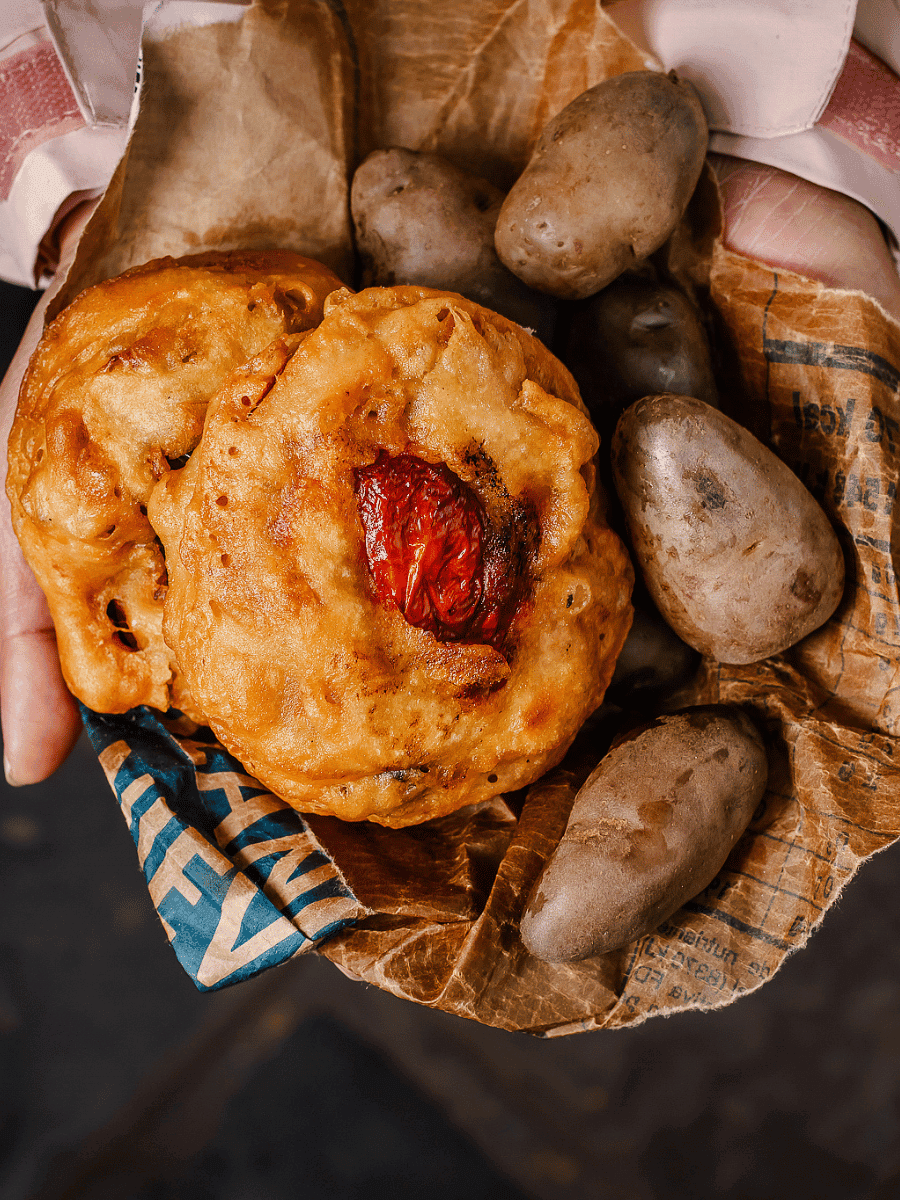
Whole scarlet rocoto peppers stuffed with spiced beef, olives, egg and cheese, baked with cream on top. Arequipa's Sunday-lunch centrepiece.

Long ridged churros piped and fried, then injected with manjar blanco or chocolate. Peru's Andean answer to Spanish churros, sold from paper cones at every fair.

Cassava batons parboiled then deep-fried until crackly golden, served with a spicy huancaína dipping sauce. Peru's Amazonian answer to French fries.

Beef stir-fried hard in a wok with red onion, tomato, ají amarillo and soy, plated with rice and hot fried potatoes. Peru's most-loved Chifa dish.

Peruvian-Chinese fried rice adapted for the Amazon: pork, chorizo, palm heart and river fish stir-fried into aromatic rice with a spoon of ají charapita. Iquitos on a plate.